
Epic's AI jam proved the next big AI tool won't build your game.It'll find your team.
Most of the 2,782 games were made by one person. The few teams got 3x the ratings per game, on fewer AI tools per person.
84.6% of the 2,782 games in the 2026 Epic AI MegaJam were made by one person (up to 90.2%).
The story
Earlier this month, more than 10,400 people signed up to build a game in four days.
A year earlier, the rules for the same jam said "Submissions may not be made using generative AI, ML, LLMs or any other similar technology." This time Epic flipped it. Up to five humans, "as many AI agents as you want," and Tim Sweeney asking everyone to "help show the world the awesomeness that AI brings to game development."
At 3 AM PT on day one, a developer posted that their Unreal MCP setup "connects but gets no level or Blueprint tools." By Sunday, someone shipping an MMO wrote "I never opened the editor." Another called their 330 AI sub-agents "my employees."
2,782 games came out the other end. 5.7x the 2025 jam, in less than half the time. AI made every developer a studio.
Two things in those games didn't fit. Almost nobody built with another person. And the few who did got 3x the star ratings per game, on fewer paid AI tools per person. One three-person team got by on $22.97 in new cash.
So what did 2,782 games teach us about the next AI tool?
The answer wasn't in anyone's prompt.
13 agents and nobody else
Starseam's developer ran "up to 13 agents at once" (@banjtheman). Thirteen workers, one human.
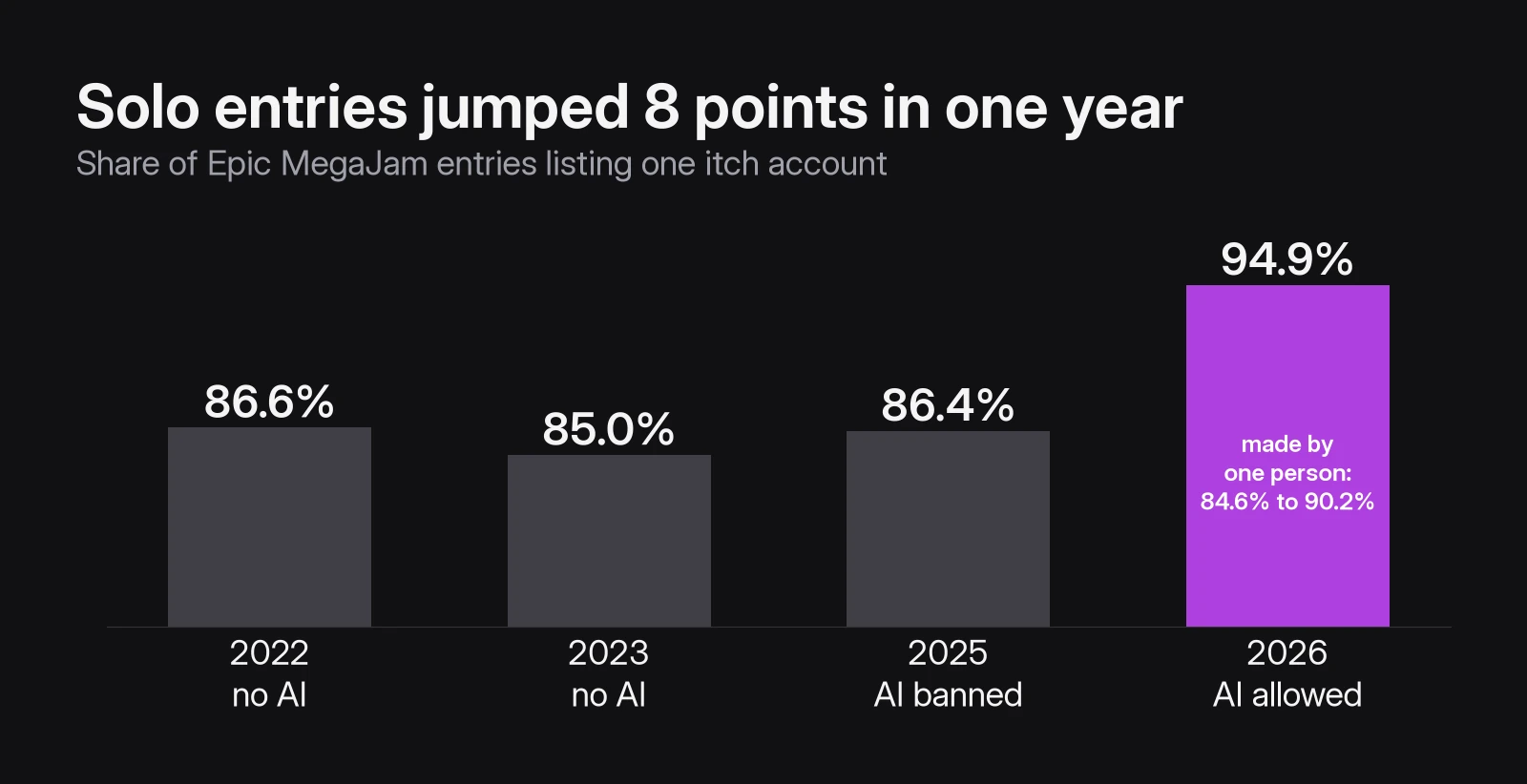
Game jams were always mostly solo. For three years the MegaJam sat within 1.6 points of 86% on itch's team field. Then AI was allowed, and in one year it jumped to 94.9%.
The real number is lower than itch's field, and still huge. 1,034 pages say it outright: one person made this. Long credits lists turn out to be lists of assets, not people.
The answer:
2,353 of 2,782 games, 84.6%, were made by one person. Up to 90.2% if every unclear one is solo.
Entrants felt it. "It felt like solo entries were expected," one wrote after submitting. "Taking on a jam alone, with AI as your partner" (@blitast_studio). One solo dev, thanking a player who said UNCUT felt complete, added: "the “entire team” was just me, directing a crew of AI agents for 96 hours" (UNCUT). A lead 3D artist who'd long had a story to turn into a game, "but never a team to make it," put it plainer:
"So AI didn't replace my team. It covered the part I couldn't cover myself."
Volodymyr Petrov, RetroStyle Games
A fish with a sniper rifle won the internet
Here's the twist. The jam's most popular game, by itch's own ranking, used no AI.
LSD:FIH is a fish with a sniper rifle. Its page says "no AI was used to make this game." Its developer, PolyCube, made it alone and posted: "I made a game for the epic's 'vibe-coding gamejam' megajam without using any ai in 4 days" (@ItsPolyCube). That post had 190,906 views by Nov 23. Kenney's "The most popular game in the Epic AI MegaJam was made without the use of AI. Hilarious, I love it" had 400,135 (@KenneyNL). Epic's own wrap post had 20,586.
Then the press piled in: Kotaku, Rock Paper Shotgun, GamesRadar+, Automaton. Automaton, citing itch founder Leaf Corcoran, notes that itch's Popular sort runs on "page views, downloads, and player numbers," so attention feeds attention.
30 to 351 itch ratings for LSD:FIH, from day one to Nov 23.
So one person can break through. Spectacularly. That's real, and it matters.
But look at what it took: one game out of 2,782, and a joke that happened to land with Kenney's 130,000 followers and then the press. Nobody we found split the field into solo and team. The story everyone told was AI vs no AI. Underneath it was a different one: one game against 2,781 others, most of them made alone, all asking for the same players at once.
Alone can still win. It's just a lottery.
Measured against games people already know
Here's the catch with being able to do more. You're still making a game. And a game gets judged against every game the player already loves.
You can hear it in the day-one comments. "Reminds me of Noita!" (ARTIFACT). "You should see how many hours I've put into Papers, Please on Steam" (Rest in Paperwork). "Reminded me of something like Chrono Trigger in real time" (Twin Souls). The highest praise was about a game that didn't exist yet: "Not gonna lie I'd buy a full game" (Last footage).
Even the jam's most popular dev framed it as a comparison. PolyCube said they made LSD:FIH because "I wanted to see how will my game turn out compared to the slop games submitted to the jam" (LSD:FIH). The press told it the same way: AI vs no AI, jam game vs real game.
And most games never got compared to anything:
80.7% of the jam's games got no rating and no comment on day one.
One person with a crew of agents can now make something that looks like a game you know. Living up to it in four days is a different job.
More time shrinks the gap
This part is my read of the data, not a measurement.
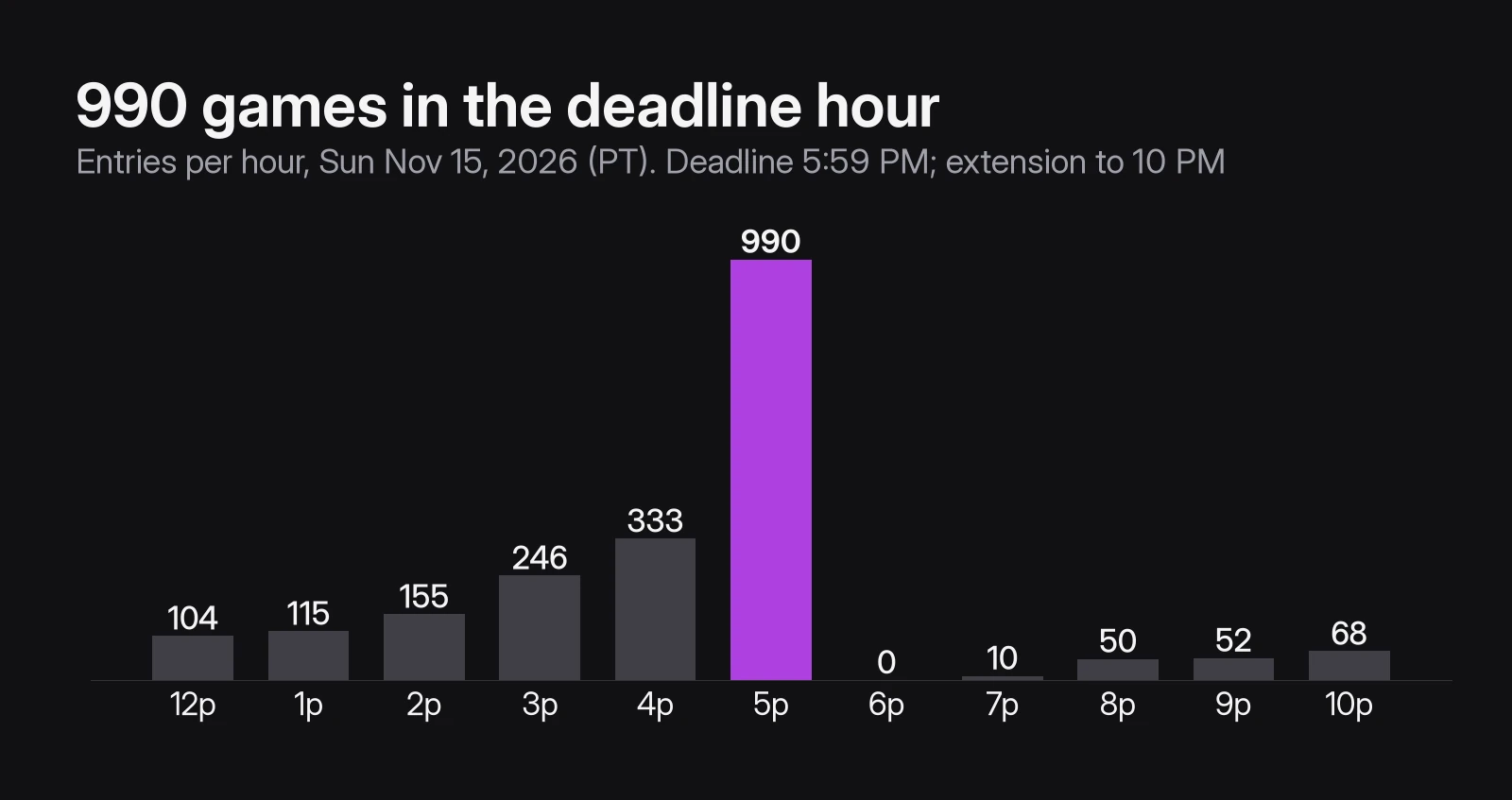
The jam ran 93 hours. The 2025 MegaJam ran 201. Only 5.5% of games were in before the final 24 hours. The median Unreal desktop build was 648 MB, itch's staff posted that "builds are taking quite a bit longer than normal," and one entrant summed it up: "somehow the upload was the final boss" (@Hacktivate16708).
The complaints weren't about agents writing bad code. Of 92 public problem reports, 51 were about uploading, submitting, web export or packaging. 9 were about AI tooling.
990 games landed in the deadline hour. 347 in the last ten minutes.
So most solo games weren't stopped by what AI could build. They ran out of clock. And plenty of people weren't done. 828 games, 30.0%, link a devlog. "After the jam I'll keep working on One More Take until it's finished and polished," one solo dev wrote (One More Take).
The tools are still getting faster, too. METR, which measured AI slowing experienced developers down in early 2025, now says "it is likely that developers are more sped up," while calling its own new data "only very weak evidence" (METR 2026).
Give one person and their agents four months instead of four days, and I think the gap to the games people know gets a lot smaller. Not closed. Creeping closer.
Everyone hired the same crew
One developer described their setup as "1 person - 12 orchestrators, 3 machines," and put the bill at "40 billion tokens ($25,000 in API rates!)" (@nazimadakli). Another built for "~$100 in ~60 hours" (@markfersh). The posted bills run that whole range. They're self-reported, and they're the loud ones.
What's quieter is how much of it was the same thing, bought over and over. 599 solo devs named both Claude and OpenAI products. 379 named a coding model, a 3D generator and an audio tool, each on their own account. Claude alone shows up on 52.8% of all pages.
Put it per person and it's stark:
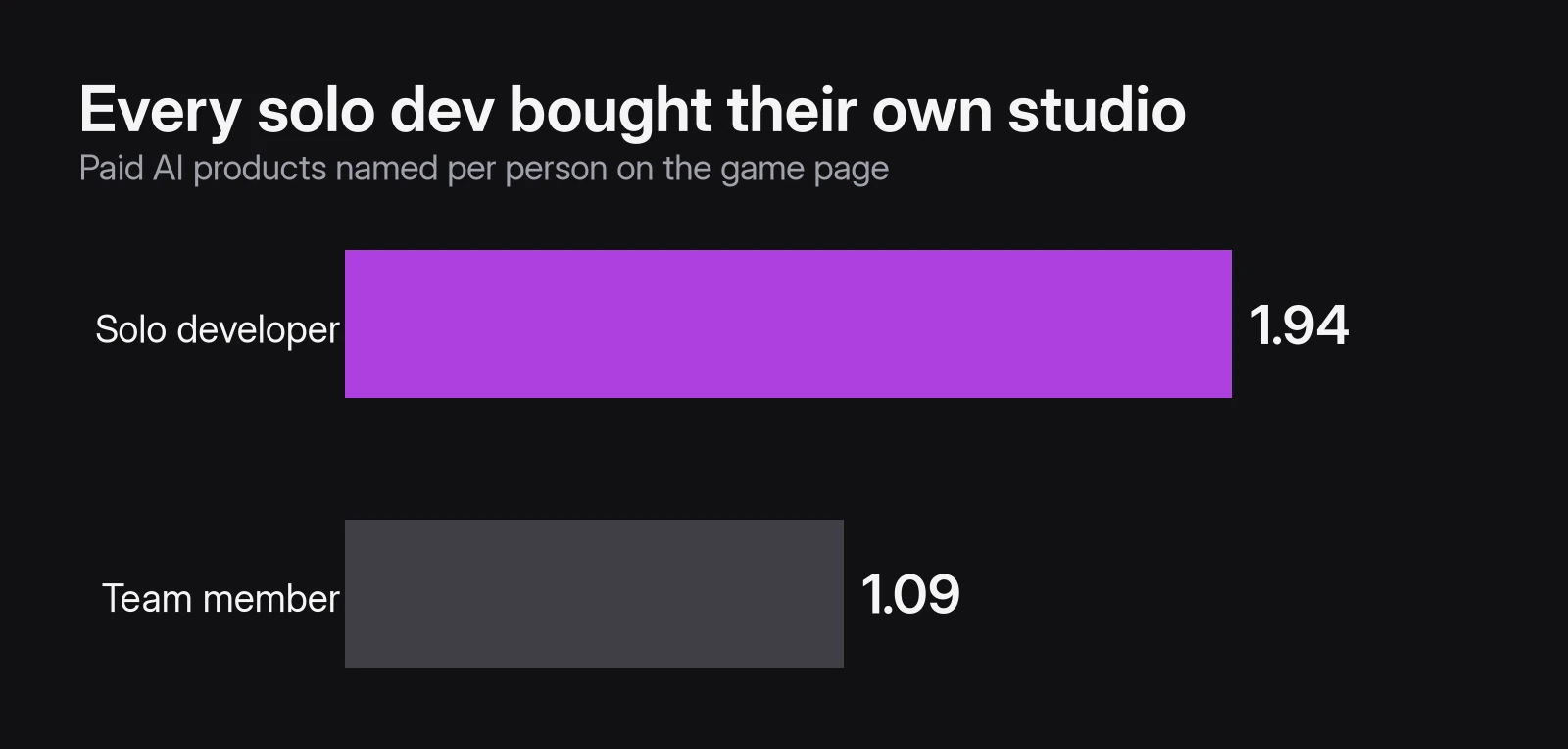
1.94 vs 1.09 paid AI products named per solo developer vs per team member. A team ran one stack for 2.6 people.
Listen to the words people used. "My employees." "Orchestrators." "The crew."
The team didn't disappear. It became a bill.
The team that spent $22.97
Now the teams.
Three people made A: Alice, the Gathering. A girl, a giant rabbit, a teapot-shaped creature to outwit. They put in about 130 hours between them and reported $22.97 in new cash for the whole jam. The rest, about $2,927 of Claude Code and Higgsfield use at list prices, came from subscriptions and credits they already had (PowerHub, from the team's own records).
Compare one solo dev, building a game called STILL, who posted "$5,653 so far" at list rates by day 4 (@cosmintrica). Different tools, different pricing, both self-reported. It's an illustration, not a measurement. But it's the shape of the thing.
Teams didn't buy five copies of everything. "Four humans each directed their own Claude Opus 5.5 agent," one team wrote (Thovex devlog). One person, one agent, one shared game. Team members named 1.09 paid AI products each, against 1.94 for solo devs. Partner perks were "one per person," so a team of five got five sets of credits and pointed all of them at one build.
And they aimed higher with it. Among teams on itch's own team field, 16.3% had a multiplayer signal, against 10.5% of everyone else, and 48.9% named a 3D generator, against 37.9%. Then players showed up:
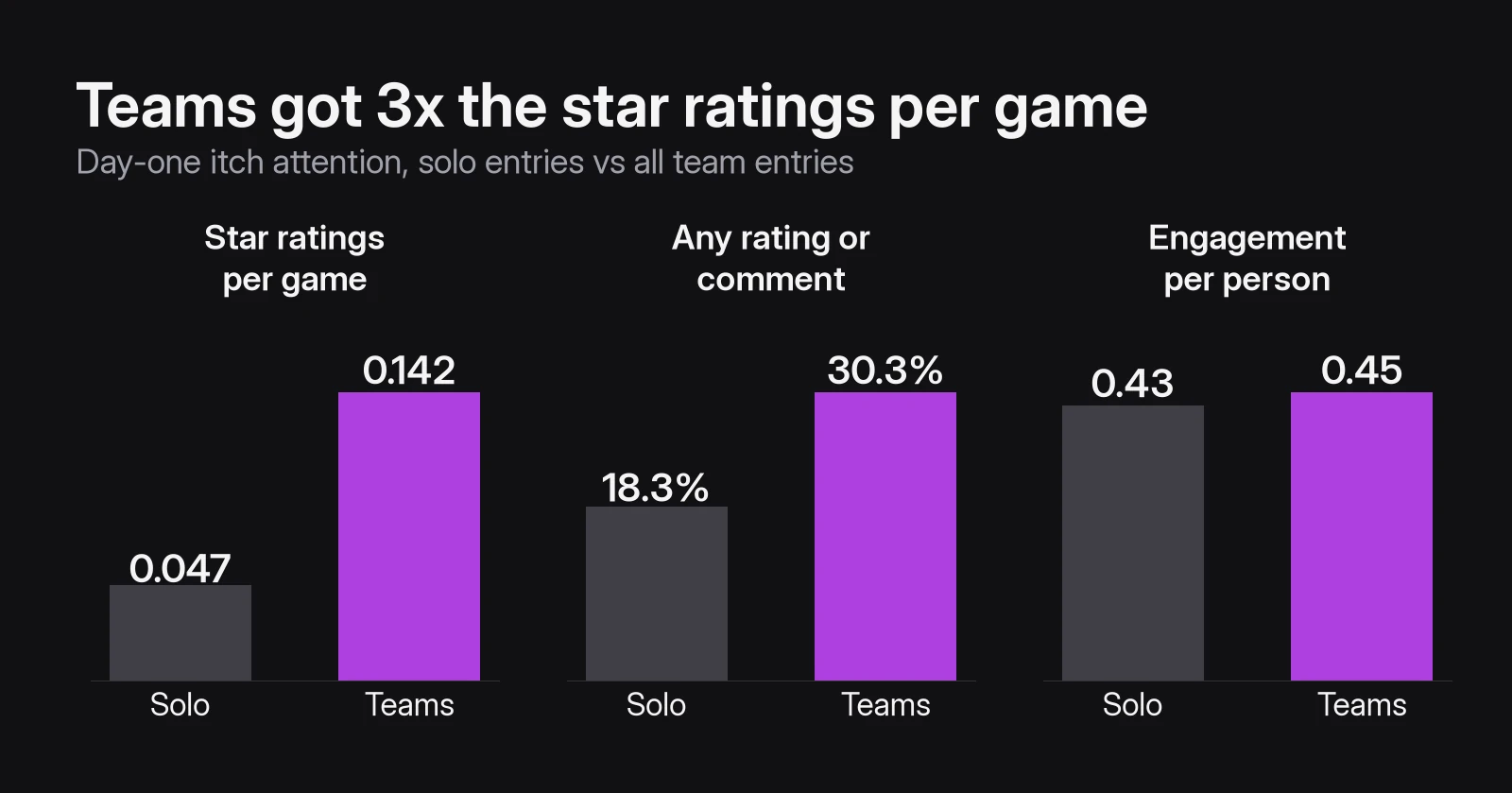
3x the star ratings per game for teams: 0.142 vs 0.047. 30.3% of team games got any rating or comment, against 18.3% of solo games.
Per person, attention came out about even: 0.45 ratings and comments per head on teams, 0.43 for solo devs. So each teammate drew what a solo dev drew, from one shared game and a little over half the paid AI tools. Coordination wasn't free. 43.4% of team games landed in the final hour, against 34.8% of solo games. But specialized people whose skills overlap made one better-noticed game, on fewer subscriptions each, than most people managed alone. Nothing in anyone's AI stack does that part yet.
Teams didn't just get more. They paid less to get it.
What the research says
The outside research doesn't let anyone off easy.
AI really can stand in for part of a teammate. In a field experiment with 776 P&G professionals, "individuals with AI matched the performance of teams without AI" (NBER). But the same study found teams with AI were 9.2 points more likely to produce a top-10% solution, while the effect for individuals with AI was "not statistically significant" (HBS Working Knowledge). Other work found AI-assisted stories were "more similar to each other," "an increase in individual creativity at the risk of losing collective novelty" (Science Advances). And only 17% of developers say agents improved collaboration on their team (Stack Overflow 2025).
AI gets one person to good. In the study, the standout work still came from teams.
The next AI tool is a matchmaker
Back to the question I started with. The next AI tool worth building isn't a better builder.
One person can do far more than a year ago. 2,353 people each shipped a game in four days, and one of them won the internet with a fish. But a game is still a game, held up against the ones players love, and four days alone rarely gets there. With more time, it will get closer.
Teams got there faster, and for less. What was missing wasn't capability. It was the other people.
Epic's only official way to find teammates was a thread called Looking for teammates? Start here. Writers posted. Narrative designers, level designers, 2D artists, animators, a producer. Of the 27 people who offered themselves or a team, 13 led with a role that isn't code. People with taste looking for someone to ship with. People with agents looking for direction.
Writers, artists and coders all showed up. They just couldn't find each other.
Then it stalled. Matches moved to "add me on discord." Posters came back days later to ask whether anyone had found a team yet. By Sunday the thread had turned into a help desk for failed uploads.
49 people in Epic's official teammate thread. About 0.5% of everyone who signed up.
Some teams formed anyway, out of sight. 133 of the 274 team games list a single itch account, so itch's own field misses about half the teams. "Can two dudes with $20-a-month AI subscriptions make a full-featured MMO in four days?" one page asks (Hollywoodland).
So that's the tool I'd bet on. Not another model, but a matchmaker: one that pairs developers whose skills cover each other's gaps, the writer who needs a coder and the coder who needs an artist, then runs them on one AI budget instead of five overlapping seats, with one build and one upload. Today that match is a forum thread with 49 people in it.
Results are due Jan 29, 2027. If team entries place far above their share, that's the next story.
AI gave everyone a studio. Nobody gave them a team.
Connor Ellison
The numbers
- 2,782 games in 93 hours, 5.7x the 488 entries of the 2025 MegaJam in 46% of the submission window (93 vs 201 hours). Epic counted "10,400+ registrations and 2,700+ entries" (@UnrealEngine, Nov 18).
- Solo share on itch's team field: 86.6% (2022), 85.0% (2023), 86.4% (2025), 94.9% (2026). Made by one person: 84.6% to 90.2%. 274 (9.8%) were teams.
- Paid AI products named: 4,560 across 2,352 solo pages (1.94 each); about 764 for 701 team members (1.09). Claude on 52.8% of pages, Claude Code by name on 37.2%, OpenAI 35.4%; Tripo, Meshy or Rodin on 38.5%.
- A rough illustration, not a measurement: if solo devs had shared tools at the team rate, they'd have needed about 2,560 seats instead of 4,560. At $20 a month a seat, about $40,000 a month of parallel subscriptions.
- Posted bills (self-reported): "~$100" (Runecraft), "$1,585.23 of Cursor usage" (UAC: Hellscape, @MrAarseth), "$25,000 in API rates" (National Xenographic), "$61,600 uncached token costs ($820 out of pocket)" (@PlayUGC).
- Teams aimed higher (teams on itch's team field, n=141, vs everyone else, n=2,617): multiplayer signal 16.3% vs 10.5%, a 3D generator named 48.9% vs 37.9%. Team games landed in the final hour 43.4% vs 34.8% of solo games.
- Follow-up: 828 games (30.0%) link at least one itch devlog post; 6 link a Steam page.
- Day-one engagement: 80.7% of games got no rating or comment. Team games 0.142 star ratings each vs 0.047 solo; 30.3% vs 18.3% got any. Per person 0.45 vs 0.43.
- Shipping: 156 entries (5.6%) fell off the pipe: late even after the 10 PM PT extension that entrants reported (67), no playable build (74), or page gone by the next afternoon (24), overlaps removed. Only 5.1% were playable in a browser, and 35.7% of those got a rating or comment vs 18.4% of download-only games.
- No-AI entries: 50 (1.8%) carry itch's "No generative AI was used" tag.
- Counts keep moving: itch showed 2,784 on the morning of Nov 16 (AIGamer), 2,776 by Nov 21 (VibeStack Weekly) and 2,779 on Nov 23. GameLook (www.gamelook.com.cn/2026/11/606687, http only) first reported 3,000+, then 2,000+ (www.gamelook.com.cn/2026/11/606919, http only). We use the 2,782 we pulled.
Methods and limits
- Census, not sample. All 2,782 entries in itch's public list, every rate page and 2,758 game pages, pulled Nov 16, 2026, 11:03 AM to 2:11 PM PT. 24 pages were gone.
- Solo means one itch account, no public credit naming another person, and no sign of a teammate on the game page, devlog or X posts, read by hand (assets, AI tools and hired voice work don't count). In a random sample of 100 games marked solo, 1 was a team. Prior years use itch's team field only, so compare 86% with 94.9%, like with like.
- Engagement is itch star ratings plus comments on day one. Jam ratings are off because Epic's judges decide. Ratings can be gamed: GameLook reported one entry whose 30+ five-star ratings came from accounts under 70 minutes old, so we only read them at group level.
- Tools count names on the page, not use. They're floors. Bills are 13 self-reported posts, not audited.
- Causality. Nothing here proves AI caused the solo shift. The jam also got shorter (93 vs 201 hours), and a shorter jam favors solo work.
- Snapshot. Day-one data, except LSD:FIH's ratings and the X view counts, read Nov 23, 2026.
Sources
- Jam: itch.io jam page · entries · Epic announcement thread · partners · 2025 MegaJam thread · teammate thread
- Epic on X: @UnrealEngine, Nov 18 · @UnrealEngine, Oct 22 · @TimSweeneyEpic, Nov 11
- Entrant posts quoted: @botmancer · @banjtheman · @PlayUGC · @markfersh · @MrAarseth · @nazimadakli · @Hacktivate16708 · @Danat_Sh · itch support thread · Hollywoodland · LSD:FIH
- Press: PC Gamer · GamesBeat · Engadget · Inven Global on UE 5.9 · levels.io
- Coverage: Kotaku · Automaton · Rock Paper Shotgun · GamesRadar+ · AIGamer · VibeStack Weekly · GameLook, Nov 18 (www.gamelook.com.cn/2026/11/606687, http only) · GameLook, Nov 23 (www.gamelook.com.cn/2026/11/606919, http only) · PowerHub · RetroStyle Games · Thovex devlog · @blitast_studio · @MifBridge · @ApkalluWorks · @cosmintrica · @ItsPolyCube · @KenneyNL
- Research: Dell'Acqua et al., NBER · Organization Science · HBS Working Knowledge · Doshi & Hauser · METR 2026 · Stack Overflow 2025 · Carta · GDC Nov 2026 · Fortune
Connor Ellison · Blazium Games We're game developers who research how games actually get built and shipped. Data and methods are public above; corrections welcome.
Comments
No comments yet.
Log in to leave a comment.